
Built Not Born Podcast · 11 September 2026
Why Amelia Sordell Shut Down Her £4M Agency She Built a Prison, Not a Business
Amelia Sordell on building Klowt, realising the agency had become a prison, and redesigning a growing business around margin, responsibility and founder freedom.
 FeaturingAmelia SordellPersonal Branding Strategist and Founder, Clout
Episode guide
About this episode
Amelia Sordell joins Chris and Helen to talk about what happens when a fast-growing business starts taking more freedom than it creates. The conversation traces Amelia's path from selling second-hand clothes as a teenager and building the fashion label Either Side, through recruitment and marketing, to launching Klowt in 2020. She explains why sales and attention came naturally to her, but why learning the less glamorous parts of business, including costs, cash, margins and operational control, mattered just as much.
A major theme is the gap between growth that looks impressive from the outside and a business that works for the founder on the inside. Amelia describes Klowt growing rapidly into a personal branding agency with clients across several countries and a team that reached nearly 20 people. At one point payroll was around £100,000 a month while revenue was around £170,000 a month. The turning point came on a family holiday when she was still being pulled into a staff dismissal and an unhappy client. Watching her family enjoy the time she was meant to be sharing with them, she realised the agency had become a prison rather than the source of freedom she had wanted to build.
Amelia explains how she began unwinding that model. Rather than replacing every person who left, the team became smaller and Klowt shifted away from agency delivery towards consulting and training. She says the newer work produced much stronger margins and better results because the client's own team could apply the methodology every day, rather than relying on an external agency capturing and posting content at intervals. The discussion is candid about redundancies, hiring mistakes, changing offers, testing ideas that did not scale and publicly changing direction when the evidence said the old model no longer fitted.
The episode also goes back to the lessons Amelia took from her first fashion business. A large retail customer collapsed after ordering £120,000 of stock, leaving her without the liquidity to fund the next collection. She is clear that the customer's collapse was not her fault, but the wider vulnerability of the business was still her problem to understand. That experience shaped a more disciplined view of cash, tax, payroll, profitability and the real cost of delivering work. It also led to one of the episode's strongest founder lessons: responsibility is not the same as blame, but the owner still has to make sure the problem gets solved.
Personal branding runs through the whole story. Amelia explains why people buy from people they recognise and trust, why disagreement online can be evidence that content is reaching beyond an existing audience, and why human stories often outperform polished corporate messaging. The conversation finishes with a different way to plan a company: decide what the owner actually wants to earn and what kind of life the business should support, then reverse engineer the model around that. For founders chasing turnover, team size or a future exit, it is a useful challenge to ask whether the business they are building is one they will still want to own when it gets there.
Key takeaways
What you'll learn
- Growth can create a bigger business while reducing the founder's freedom if decisions, staff issues and client problems still depend on them.
- Sales and attention are not enough on their own. Founders need a working understanding of costs, cash, tax, payroll, margins and liquidity.
- A problem may not be the founder's fault, but the founder remains responsible for ensuring the business can solve it.
- Klowt's shift from agency delivery towards consulting and training shows why a business model should be judged on margin, results and founder dependence, not only revenue.
- Personal branding works when content feels human, useful and distinctive enough to create recognition, trust and conversation.
- A useful way to design a business is to start with the income and life the owner wants, then work backwards to the model required to support it.
Questions from this episode
Frequently asked questions
Why did Amelia Sordell move Klowt away from the agency model?
Amelia says the agency had become too dependent on her. Even with a larger team, difficult staff issues and unhappy clients were still reaching her while she was on holiday. She gradually reduced the team and shifted Klowt towards consulting and training, which she describes as higher margin and more effective because the client's own team can apply the methodology day to day.
How did Amelia Sordell start Klowt?
While working in marketing for a private equity business connected to recruitment, Amelia began receiving inbound questions about how she had built her own online following. She delivered personal branding workshops, saw clear demand for the service and launched Klowt in 2020 with £1,400 in her bank account and no large financial safety net.
What did Amelia learn from the failure of her first fashion business?
She learned that strong sales and marketing do not compensate for weak financial control. When a retailer collapsed after placing a large order, she was left with £120,000 of stock and insufficient liquidity to create the next collection. Looking back, she says a deeper understanding of costs, cash and reserves would have made the business more resilient.
What is Amelia Sordell's approach to personal branding?
Her approach is strongly human-centred. She argues that people care about whether a business can solve their problem and whether they like and trust the person behind it. Relatable stories, opinions and real experiences can therefore create attention and connection that conventional corporate posts often struggle to achieve.
How does Amelia think founders should set business goals?
Rather than starting only with turnover or exit value, Amelia suggests deciding what the owner actually wants to earn and what lifestyle the business should make possible. The business model can then be reverse engineered around the required profit, team costs, future savings and the amount of founder involvement that still feels worthwhile.
Resources from this episode
Put the ideas into practice.
Download the practical resources created from this conversation.
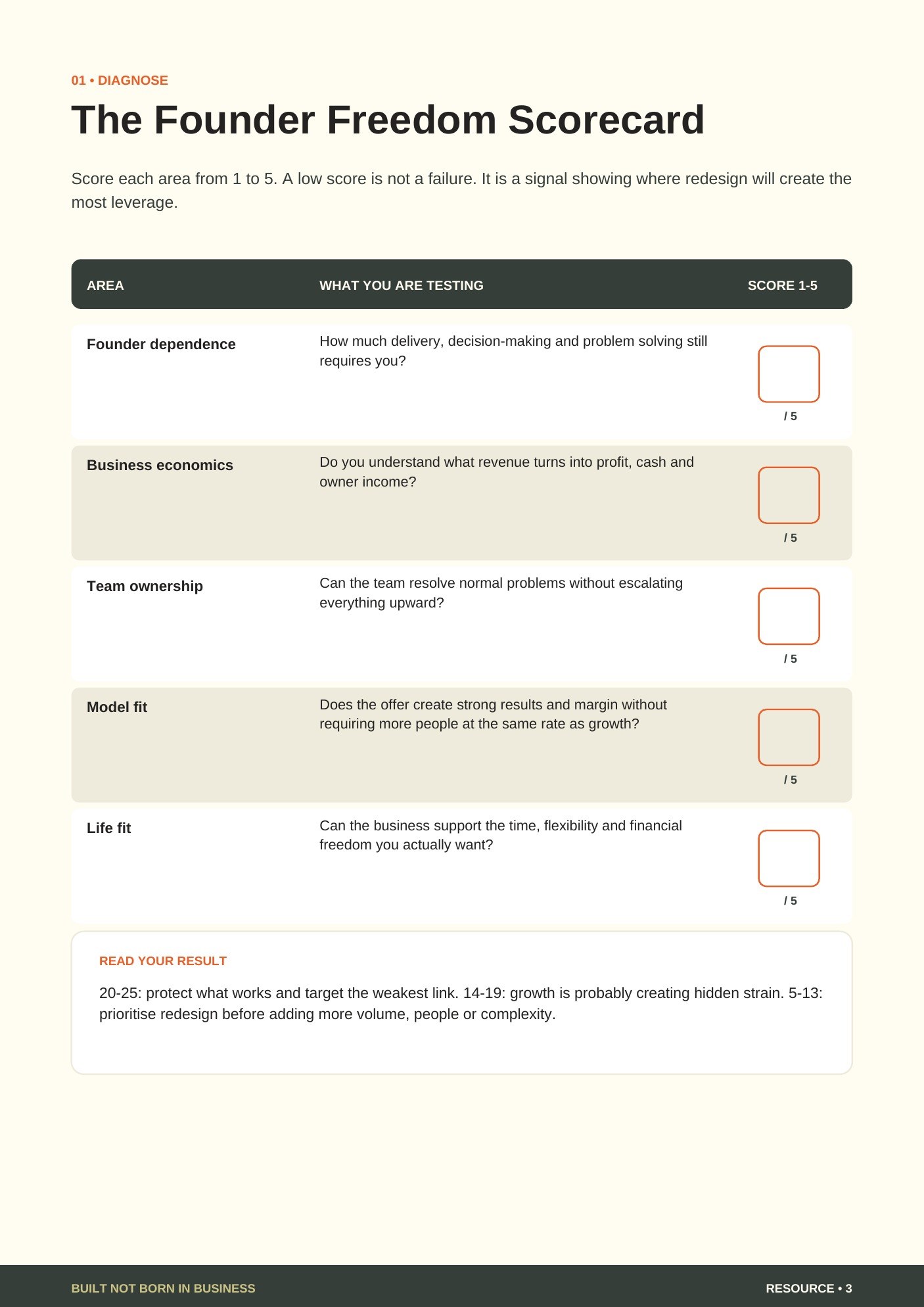
The Founder Freedom Business Audit
A practical workbook for founders who want to spot where growth has made the business too dependent on them, then redesign the model around stronger economics, clearer ownership and the life they actually want to lead.
Get this resource →