
Built Not Born Podcast · 14 August 2026
How Dom McGregor & Steven Bartlett Built a Social Media Giant at 19
Dominic McGregor on building Social Chain with Steven Bartlett, compounding social media strategy, founder pressure and life after exit.
 FeaturingDominic McGregorEntrepreneur, Investor and former Co-founder of Social Chain
Episode guide
About this episode
Dominic McGregor started experimenting with social media as a university student, long before it looked like a conventional business. He created Student Problems after tweeting about the everyday frustrations of student life, then grew the account to around 50,000 followers as Twitter evolved and visual meme culture took off. That audience brought him into contact with Steven Bartlett, who was building a student website called Wallpark. They met in York, realised their strengths were complementary and began building more student media assets together. Dominic argues that their age helped rather than hindered them. At 19, they had enough naivety to treat running social accounts, speaking to brands and working from Thailand as a normal way to build a company.
The commercial model emerged when advertisers repeatedly chose access to their large social audience over the website traffic they could offer. Dominic says the pair eventually had around one million followers across platforms, giving them a practical answer when brands asked why they should trust two young founders with social media. Social Chain grew from that operating experience. Dominic describes early clients including PrettyLittleThing and Spotify, both of which were still challenger businesses at the time. He also explains how social budgets matured: the first year might be an experimental pot, the second a more consistent social budget, and the third a channel-by-channel investment in areas such as influencers, ambassadors and specific platforms.
A major theme in the episode is the difference between copying tactics and understanding the principles underneath them. Dominic says competitors could imitate steps four, five and six, but they could not see steps one, two and three. For him, that meant having a clear reason for what the company was building, understanding an audience first-hand and staying close to practical execution. The same logic shapes his current view of social media. He believes brands are too easily distracted by viral hits and vanity metrics, when the stronger strategy is to repeat something useful and let it compound. He points to M&S as an example of a brand where visible social success sits on top of years of work on product, positioning and customer affection, with people-led content amplifying something that already has substance.
The conversation also moves into the psychology of building at speed. Dominic identifies self-belief as one of the strongest traits in his own journey and describes imposter syndrome as a temporary gap between actual capability and perceived capability when someone is pushing into unfamiliar territory. He and the hosts discuss how discomfort can accompany growth, while Dominic also talks openly about periods of anxiety, depression and heavy drinking during Social Chain's rapid expansion. He describes alcohol as something he was using to cope with pressure, and explains that stopping drinking was part of taking responsibility for the person he wanted to become. These are Dominic's personal reflections, not a clinical framework, but they add an important layer to the story of rapid founder growth.
When Dominic and Steven eventually left Social Chain, the challenge changed again. Dominic recalls how quickly his WhatsApp changed from constant work messages to silence, revealing how much of his identity and perceived importance had been tied to the company. He describes the financial outcome as less dramatic than the earlier realisation that he would be fine regardless of what happened next. Six years on, he invests in early-stage businesses, runs an academy helping young people enter the social and digital economy, and thinks differently about success. Time with his son, his wife, friends and family now sits alongside ambition. The episode is a wide-ranging look at what it takes to spot an emerging opportunity, build practical expertise faster than the market, stay aligned with a co-founder and then work out who you are when the company no longer needs you.
Key takeaways
What you'll learn
- Practical audience ownership can be a stronger competitive advantage than theoretical knowledge of a platform.
- Being early matters, but Social Chain also won because the founders could prove they were operating social media successfully every day.
- Brands can move social media from experimental spend to core budget by producing repeatable evidence rather than one-off excitement.
- Copying competitors shows you their visible tactics, not the first-principles reasoning that produced them.
- For brands, consistent social media strategy is more durable than chasing viral hits and vanity metrics.
- Co-founder alignment is easier when both people are clear on the goal and trust each other to own different strengths.
- Dominic views self-belief as a defining part of founder development and sees some feelings of imposter syndrome as a sign of pushing into new territory.
- An exit can remove the role, attention and identity a founder has lived with for years, creating a new question: who are you when the company no longer needs you?
Questions from this episode
Frequently asked questions
How did Dominic McGregor and Steven Bartlett meet?
Dominic had grown the Student Problems social media account while at university. Steven Bartlett was building a student website called Wallpark and contacted Dominic after seeing the account grow. They met in a bar in York, compared what they were trying to build and decided they could achieve more by working together.
How did Social Chain grow from student social media accounts into a business?
Dominic says the turning point came when advertisers preferred access to their large and engaged social audiences over the smaller traffic going to their website. That gave the founders a clear commercial proposition: they understood how to reach young people because they were already operating those audiences every day. From there, they built more niche audiences and expanded into social media marketing services for brands.
What does Dominic McGregor say about going viral on social media?
Dominic argues that viral hits are a weak long-term strategy for brands. His view is that social media works better as a compounding system: choose a clear audience and strategy, repeat useful work, improve it over time and build a brand people already care about. He distinguishes that from chasing short-term vanity metrics such as views alone.
What does Dominic say about first-principles thinking in business?
Dominic says competitors can copy the visible steps of a business, but they cannot easily copy the earlier reasoning that produced those choices. He recommends having a fundamental vision, understanding why you are doing what you are doing and using that logic to guide decisions instead of simply copying competitors.
Why did Dominic McGregor decide to leave Social Chain?
Dominic describes 2020 as a period that created unusual space to think. During COVID, the office was empty but the business kept running, showing that it no longer depended on him in the same way. At 27, he began asking what he wanted the next stage of life to look like. That combination of changed priorities, reflection and a business that could operate without the founders helped lead to the decision to exit.
Resources from this episode
Put the ideas into practice.
Download the practical resources created from this conversation.
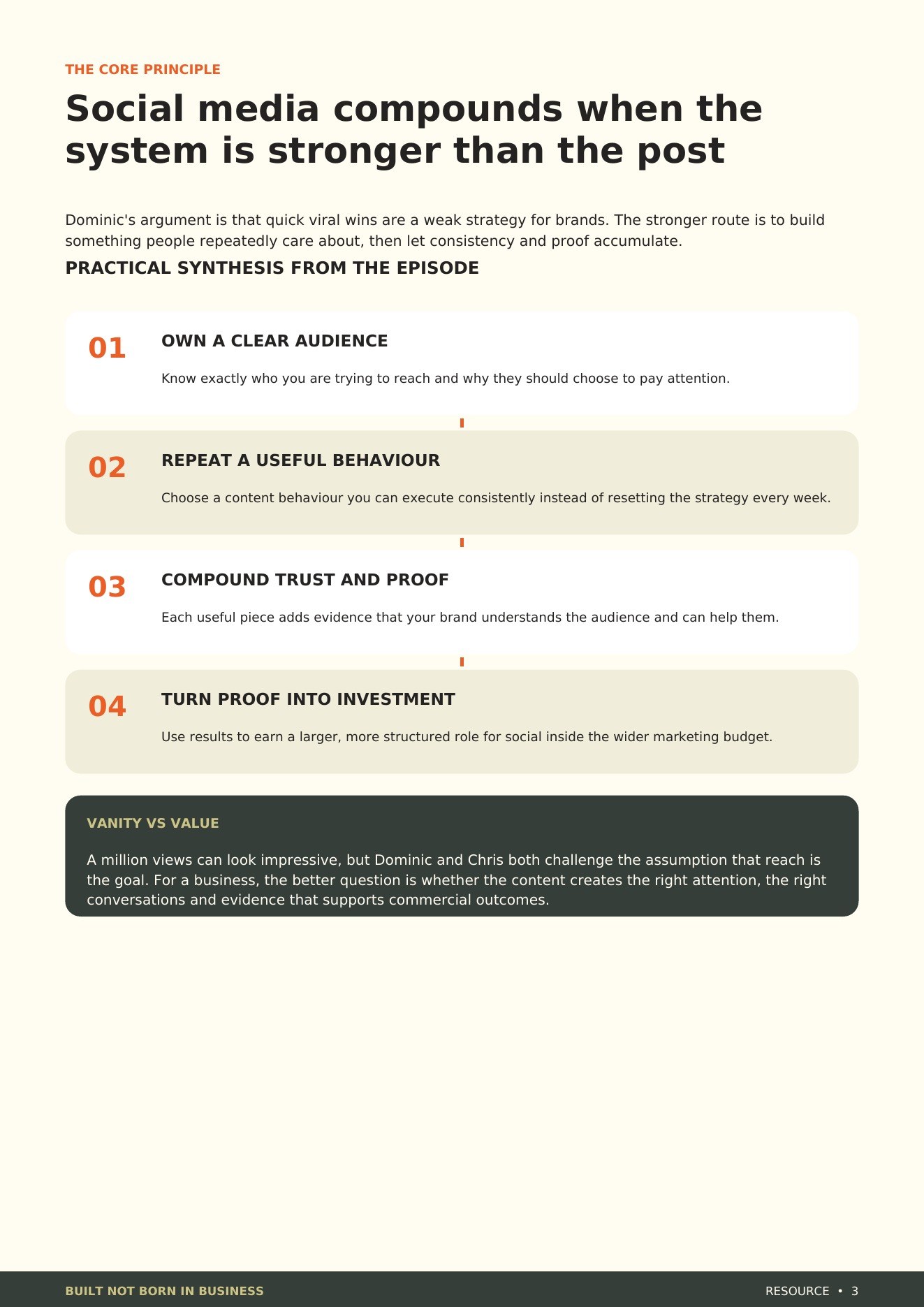
The Social Media Compounding Blueprint
A practical workbook based on Dominic McGregor's explanation of how Social Chain built an advantage through audience ownership, first-principles thinking and repeated execution. It helps founders and marketing teams replace viral chasing with a clearer social strategy, define the audience they want to own, map the path from experimental spend to consistent investment and turn the thinking into a 30-day operating plan.
Get this resource →