
Built Not Born Podcast · 3 July 2026
The Secret to Endless Motivation as an Entrepreneur
How do you keep moving when business motivation disappears? Chris and Helen share the practical resets they use when entrepreneurship feels heavy, noisy or lonely.
Episode guide
About this episode
Entrepreneurial motivation is rarely a steady upward line. In this episode, Chris and Helen Butler talk candidly about how quickly the emotional temperature of running a business can change. Chris describes being on a huge high after securing an exciting podcast guest, then waking up the next morning feeling flat again for no obvious reason. That contrast sets up the real question behind the episode: when the big goal is still there but the day-to-day motivation disappears, what can a business owner actually do?
A major theme is the value of talking honestly with other business owners who are still close enough to the realities you are facing. Chris and Helen describe a small group they meet with to share successes, problems and practical experience without the usual guardedness. They argue that friends and family can care deeply but may not fully understand the pressure, and that advice from someone much further ahead can sometimes miss the financial or operational constraints of a smaller business. The useful support is not necessarily from someone in the same sector. It is from people you respect, who understand business now and who are willing to be honest.
The conversation then turns to focus. Both hosts recognise the endless list of jobs that comes with business ownership, but Helen explains how choosing three main priorities for the week has helped her filter what deserves attention. Chris adds a related lesson about avoidance: one important task had been repeatedly parked until an AI reflection chat kept calling him out on it and forcing him to confront the excuses. He is careful not to present AI as therapy, but the example shows how a structured check-in can help expose a task you already know matters. The wider lesson is to narrow the work, name the thing you are avoiding and create a smaller first action.
They also discuss the parts of motivation that have little to do with productivity systems. Helen talks about getting genuine time away from work, even if that means a walk alone or a conversation with friends about something completely different. Chris reflects on how quickly he moves past good news without celebrating it, while both return to the loneliness of entrepreneurship and the importance of finding people who collaborate rather than posture. By the end, the episode is less about chasing a permanent motivational high and more about building a practical reset: honest support, fewer priorities, recognition of progress, accountability, some distance from work and relationships that make the journey feel less isolated.
Key takeaways
What you'll learn
- Motivation can change dramatically from one day to the next, even when the bigger goal has not changed.
- A trusted circle of business owners can provide context and support that friends or family may not be able to offer.
- Advice is often most useful when the other person still understands the reality and constraints of your stage of business.
- Choosing three weekly priorities can stop an endless task list from dictating the week.
- A structured reflection or accountability check can expose important work you keep avoiding.
- Regularly recording wins can stop positive progress from being immediately overshadowed by the next problem.
- Small periods away from work and more collaborative business relationships can reduce the sense of isolation.
Questions from this episode
Frequently asked questions
How can entrepreneurs stay motivated when business feels overwhelming?
Chris and Helen suggest reducing the noise rather than trying to force motivation. Their practical approaches include speaking honestly with trusted business owners, choosing three main priorities for the week, recognising recent wins, confronting avoided tasks and creating some deliberate time away from work.
Why is entrepreneurship described as lonely in this episode?
They argue that friends and family may care but often do not fully understand the pressures of running a business. They also describe how guardedness between business owners can make the problem worse. A small circle of people who understand the journey and can speak honestly can make difficult periods feel less isolating.
What is the three-priority method Chris and Helen use?
At the start of the week, they identify three main areas that genuinely need to move forward. When smaller tasks appear, they can ask whether the work contributes to one of those three priorities. If it does not, it may be something to park rather than allow it to take over the week.
Can AI help with business reflection and accountability?
Chris describes using a dedicated AI chat to record highs, lows, wins and unfinished tasks. He found it useful for spotting patterns and calling out avoidance, but he is explicit that this is not a replacement for counselling, therapy or medical support when someone is genuinely struggling.
Why does recognising wins matter for entrepreneur motivation?
Chris realised that several positive things could happen in a short period and he would still move past them quickly to the next problem. Deliberately recording and acknowledging progress can give a more balanced view of how the business is actually moving, rather than allowing the next concern to erase the previous win.
Resources from this episode
Put the ideas into practice.
Download the practical resources created from this conversation.
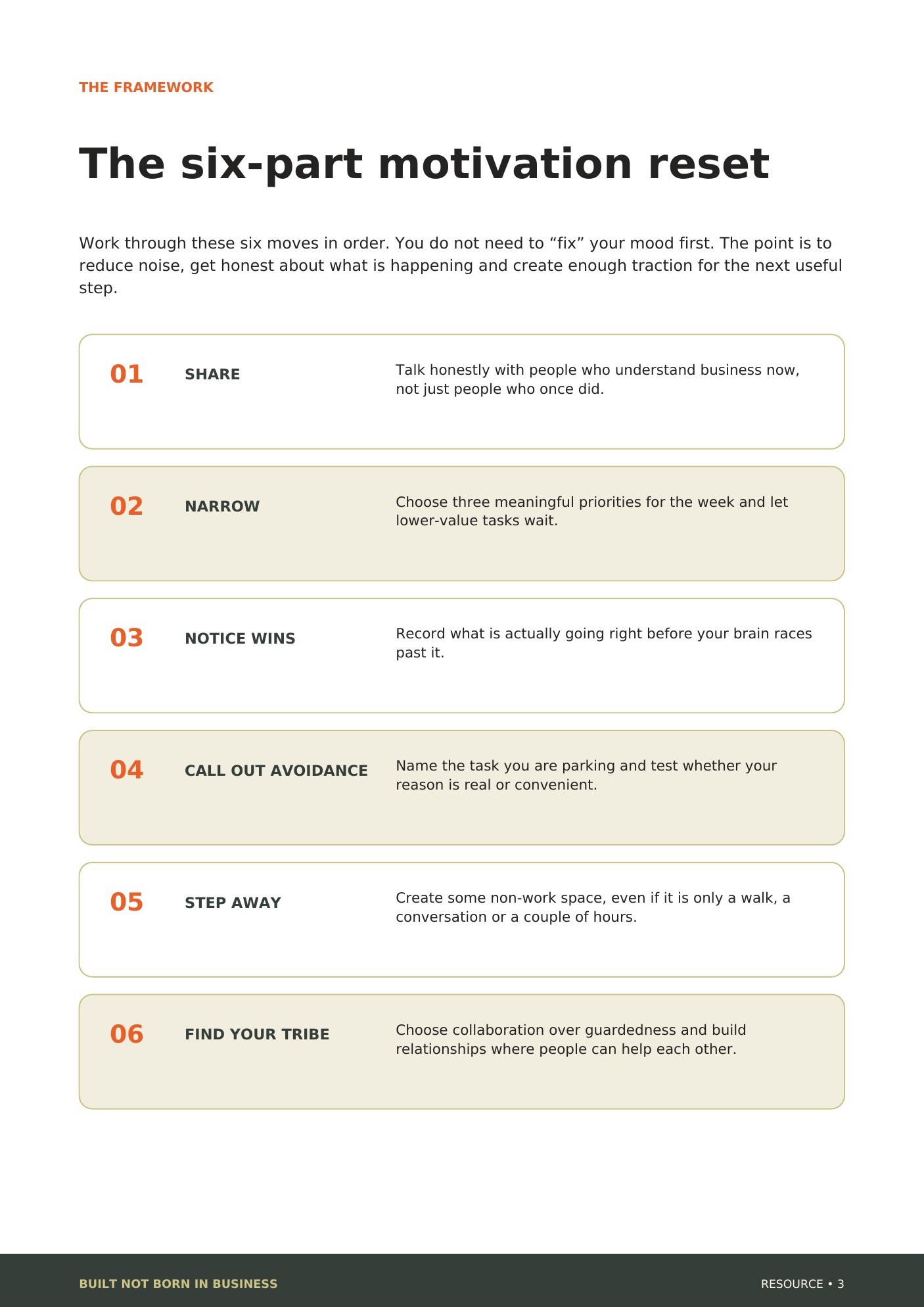
The Entrepreneur Motivation Reset
A practical 11-page workbook for business owners who feel overwhelmed, flat or stuck. It turns the episode’s strongest ideas into a six-part weekly reset covering honest support, three priorities, recognising wins, calling out avoidance, creating recovery space and building a more collaborative business circle.
Get this resource →